Showing posts with label NEWS. Show all posts

Tuesday, 19 January 2016

whatsapp-image-624x351
Popular and widely used messaging service WhatsApp is now free. The Facebook-owned company has decided to stop charging people 99 cents annually to use the service. Up until now, WhatsApp has been free for the first year, with the annual fee added for subsequent years of use.
WhatsApp founder Jan Koum made the announcement at the DLD conference in Munich and admitted, “It really doesn’t work that well.” Does this mean we will now see innumerable third party ads? Apparently not. But, the company will instead try to monetise communication in different ways.
WhatsApp said in blogpost, “Starting this year, we will test tools that allow you to use WhatsApp to communicate with businesses and organisations that you want to hear from.” The company explains that this could either mean communicating with a bank about whether a recent transaction was fraudulent, or with an airline about a delayed flight. Mostly, these kind messages (SMS) are passed on using a simple SMS. WhatsApp aims to offer tools in which, conversations can be carried out between businesses and organisations with the common man via its service, sans spam and advertisements.
Communicate with businesses and organisations. This sounds a bit similar to BlackBerry Channels or Line Messenger wherein users could head to a channel of interest and discuss about certain topics or even, contact them. As of now, the company’s approach remains unclear.
Today, WhatsApp is an integral part of our lives for communication. We depend on the service to talk to various service platforms for work. It could either be a grocery store or even an e-commerce store. If given the option, it would be far more convenient to order a smartphone via WhatsApp rather than going through the trouble of ordering it online. This process would be the simplest, instead of the other two – order online or via retail.
But then again, the only question which arises is security. If the service wishes to offer a platform where companies and consumers can make transactions, it needs to tighten up its security. It is a known fact that even the Pentagon trusts BlackBerry for their internal communication, but not WhatsApp. So would businesses blindly trust the service for intense transactions?
On the contrary, it can. WhatsApp’s parent company is Facebook, one of the biggest and strongest platform today has the man power and technical expertise to take it forward. Even revolutionise the entire structure as we know it. A report by Wired points out the deal with Facebook allowed WhatsApp to concentrate on growth without worrying too much about revenue.
Koum points out, WhatsApp has a greater global reach than nearly any other app. This gives Koum and company additional leverage. “A lot of companies are global,” he says, such as airlines and banks and car rental outfits. And these companies may be willing to embrace this kind of messaging because WhatsApp gives them more efficient access to more people than any other medium.
If this plan goes forward, there wouldn’t be much difference between WhatsApp and Facebook Messenger, a platform which also allows users to communicate with companies. For example, Facebook has struck a deal with Uber, to allow users to hail a taxi directly from the app. However, Facebook made a good decision by not meddling into WhatsApp and making various changes and added a line of new features. Though, the company kept improvising Messenger and today, it can be touted as a rich-in-media app. Another good decision is not combining them into a single app. Keeping two separate messaging apps makes a lot more sense as Messenger is popular in the US, but WhatsApp has a stronger hold in countries such as India, Brazil, Africa and others.
In conversation with Re/Code, Koum has stated that businesses are already finding ways to use WhatsApp to reach customers. The new plan, could make the flow of communication a lot easier. He said that the company wants to experiment with different approaches but added, “We haven’t written a single line of code yet.”
Possibly, WhatsApp could also look at a business-to-consumer (B2C) integration. This leaves WhatsApp as a product, and not a service. It isn’t necessary that a business perspective put in to place for WhatsApp could be a welcome change. Even without having ads, companies could send various messages, in the form of advertisements, which might irk the 900 million users and counting, it has today. That’s a huge number!
The main essence of the $19 billion acquisition in 2014 for Facebook, has remained untouched, up until now. Here’s hoping that Facebook can in fact, monetise the service, at the business’ expense and not the user!
Post appered on : firstpost

WhatsApp is now free: So, how does Facebook plan to monetise the messaging service?

Read More

Wednesday, 30 December 2015

lg_g3_back_panel_black_official
LG has finally started rolling out its much-awaited Android 6.0 Marshmallow update for the LG G3. The update has started reaching handsets in Poland and will eventually reach G3 users in other regions.
The Android update can be installed via the PC Suite app as it is not available over-the-air (OTA) for now. Both the LG G3 16GB and 32GB inbuilt storage variants are eligible for the Android 6.0 Marshmallow update. The news came from social handles of LG Poland.
Some of the new features of Android 6.0 Marshmallow (previously just Android M) include revamped app permissions; Google Now on Tap feature; new Chrome feature that will change the Web experience for Android users; new ways to handle Web links; Android Pay mobile payment system is now official with Android M; new fingerprint APIs for developers to add into their apps, New Silent feature for sound and vibrate mode as well as a 'Do Not Disturb' mode to block all sounds or only alarms and notifications, and battery saver features called Doze that will make Android devices smart about managing power. Some of the other additions include new RAM manager, adoptable storage devices, new app drawer, auto backup and restore for apps, and support for USB Type-C ports.
LG has also detailed some of the features it added in the latest Android build including battery optimisation; Knock Code settings, which will be updated to offer an improved experience for the latest OS build; Direct Share, which will show users frequently shared combinations of recommended apps and people; Silent Mode sound profile; auto-brightness improved to be brighter when in a bright place and darker in a dark place; memory settings have been added to Settings > General > Memory to be easily accessible; screen for Apps settings has been simplified, and LG Bridge has now been renamed to LG AirDrive.
It is worth mentioning that LG G4 started receiving the Android 6.0 Marshmallow update in October this year.
Post Appeared on : ndtv.com

LG G3 Starts Receiving Android 6.0 Marshmallow Update

Read More

Tuesday, 29 December 2015

android

Android App Development Course


JAVA Basics


  • Introduction to Java
  • Java Programming Structure
  • Object Oriented Programming
  • Inheritance & Packages

Android Fundamentals


  • History of Android
  • Introduction to Android OS
  • What is Android?
  • Android Versioning
  • Android Development Tools
  • Android Architecture
  • Practical Installation of Android SDK, Eclipse and ADT Plug-in
  • Structure of a Android Project
  • OOPS Concepts


Android Advanced Concepts


  • Introduction to android components / Building Blocks
  • Activities
  • Services
  • Content providers
  • Broadcast receivers

Android training in chennai

Read More

Friday, 30 October 2015

images
GREAT OFFER
JUST DOWNLOAD AND SIGN UP
GET RS: 500 ON YOUR WALLET
LINK : http://app.makemytrip.com/djcag/5

GREAT OFFER JUST INSTALL APP AND GET 500 IN WALLET

Read More

Wednesday, 28 October 2015

cebook founder and CEO Mark Zuckerberg on Wednesday said that he supported net-neutrality "100%", but added that he also strongly backed zero-rating.
Facebook's initiative, In ternet.org, rebranded as `Free Basics' a couple of months ago, has generated much debate on the subject. The service, delivered in collaboration with telecom operators, allows access to online content on "basics" such as health, education and employment and subscribers aren't charged for the data used.

Activists argue that such "zero-rating" pla ns go against the principle of net neutrality . But Zuckerberg believes that's "going too far". Answering questions at Facebook's first Town Hall Q&A in India, held at IIT-Delhi, he said: "Net-neutrality is a very important principle and we do a lot to support it in terms of pushing for regulation. This debate (exists) because countries are trying to figure out what their regulation should be." As loud cheers rang out at IIT-Delhi welcoming Mark Zuckerberg to the capital, cyber experts in the city voiced their concerns over Facebook's internet.org initiative. While the founder of the social networking powerhouse claimed that the views of people not connected to the internet were being ignored in the ongoing debate, net-neutrality advocate Nikhil Pahwa blamed Facebook for creating a "false choice".
"Zuckerberg is asking people to choose between universal connectivity and netneutrality ," Pahwa said. The principle of net-neutrality , he added, means that the opera tor shouldn't be giving a competitive advantage to any entity whether by manipulation of speed or differing pricing.

"Free Basics (the new name for internet.org) users will primarily get access to Facebook and its partners and this effectively discourages usage of the open web," Pahwa said, pointing out that internet penetration has increased dramatically in the past six months alone -rising by 52 million new users according to the Internet and Mobile Association of India.

We really don't have a problem, according to Pahwa. "There are ways to provide free access -it has been done in Africa, Bangladesh and the government free Wi-Fi projects are also on the same format. And none of these restrict usage to just a few sites," he said.

But, speaking at the IIT campus, Zuckerberg insisted that the line taken by net neutrality proponents may ultimately harm access to the net for the very large num bers who are still not online.

"Those pushing for netneutrality have access already ," Zuckerberg said."Those not on the net can't sign a petition pushing for access. We have a moral responsibility [toward] people who do not have access."

The type of content that'll be available through Free Basics is low-bandwidth, text and "not directly cannibalizing the operator's business".The platform "isn't a filter," Zuckerberg said.


Apparently Free Basics users -about 15 million across the world -tend to become full subscribers once they realise the benefits of being connected.


Zuckerberg's in India to interact with its Facebook community -population roughly 130 million -and a tiny part of it, about 1,100, attended Wednesday's Town House on the IIT campus.


"That's the second largest Facebook community in the world," Zuckerberg said."Our mission is to connect the world and India is the world's largest democracy . For every 10 people who get access, one gets a job, one gets elected out of poverty . It is a big opportunity to develop the economy here, one of the things you can do for the world."


Speaking on social tools from the Facebook stable, Zuckerberg said the safety tracking tool was used by millions to reassure family and friends after the recent earthquake. There's also Amber Alert on Facebook -a missing child alert currently available only in Canada and USA -that was launched in January this year and "at least one child has been found using it." "In 5-10 years, we want to build computers that are better at main human senses -that can see better, hear better," he said.

Zuckerberg gets hero rating in IIT-D, insists internet.org is not a villain

Read More

Wednesday, 21 October 2015


Are YouTube’s viewers ready to pay to avoid its ads?
The world’s biggest video site will find out in a week when it launches YouTube Red, a subscription service it calls “the ultimate YouTube experience.” For $9.99 per month, U.S. viewers can watch all of YouTube’s content ad-free, play videos while using other apps on their phone and save videos for offline play. The service is $12.99 per month for people who sign up through iOS because Apple AAPL +0.00% charges an extra fee for in-app purchases.
The effort is part of a long and winding journey toward getting users to pay for YouTube. The site launched a YouTube Music Key beta last year that promised to give users many of the same options — background and offline playing — for YouTube’s vast music catalog, but this expands the access to all videos, not just those deemed as music.
YouTube is sweetening the subscription deal with original content from its most popular creators.  Top creators like PewDiePie, the Fine Brothers, Lilly Singh and Joey Graceffa are debuting high-production videos and shows that are only available on YouTube Red. Original content is coming “early next year,” the company said.
YouTube will pay creators to make some of the original content that is going to be promoted as part of YouTube Red. The company said a year ago that it would pay its top creators to make videos, but didn’t say until now that that content would be used to draw viewers into paying for a premium service. YouTube has faced worries that its star creators will defect to other sites that pay them more.
Robert Kyncl, YouTube’s chief business officer, emphasized at a press conference Wednesday that the subscription service, which will share revenue between YouTube and creators, will create a “brand-new revenue stream” for YouTube stars. Creators will be paid from the pool of subscription revenue based on how much time paid users spend watching their videos. And YouTube is serious about making sure the paid catalog is complete: if creators do not agree to put their content on the subscription service, their ad-supported content will be made private on YouTube in the U.S.

Google's YouTube Red Will Let You Watch Videos Ad-Free For $9.99 Per Month

Read More

Sunday, 27 September 2015


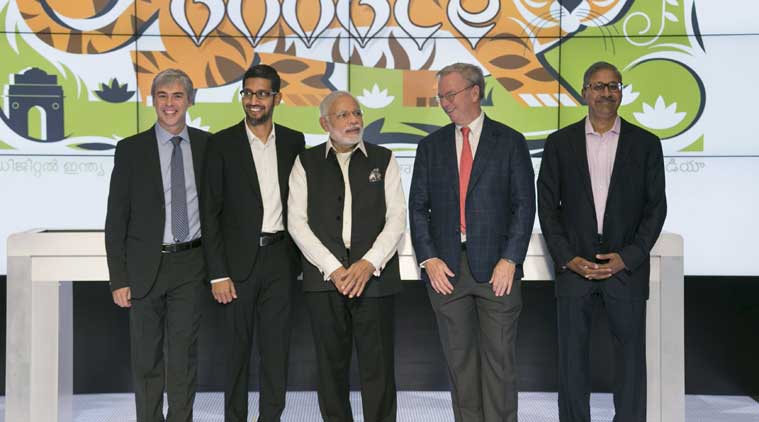
Prime Minister Narendra Modi is one of the first Indian leaders to interact with the top CEOs and business leaders of Silicon Valley, during his second US stint. PM Modi has met Microsoft’s CEO Satya Nadella, Google’s CEO Sundar Pichai and Alphabet’s CEO and Google co-founder Larry Page (the holding company of Google), Facebook CEO Mark Zuckerberg, Apple CEO Tim Cook, Qualcomm’s Executive Chairman Paul E. Jacobs, CISCO’s John Chambers and Tesla Motors CEO Elon Musk on this trip, making it a power-packed trip for any Indian leader.


The PM’s visit has also come with some key announcements and along with discussions on future possibilities of certain new technologies coming to India. We take a look at certain key announcements made during the course of this visit.
Google and WiFi at 500 Railway stations: Google has announced that it will help India set up base for free Wi-Fi at 500 railway stations.
“We are expanding our public Wi-Fi hotspots. For example, we want to ensure that free Wi Fi is not only there in airport lounges, but also on our railway platforms. Teaming up with Google, we will cover 500 railway stations in a short time,” PM Modi said at a dinner hosted by Silicon Valley CEOs in his honour.
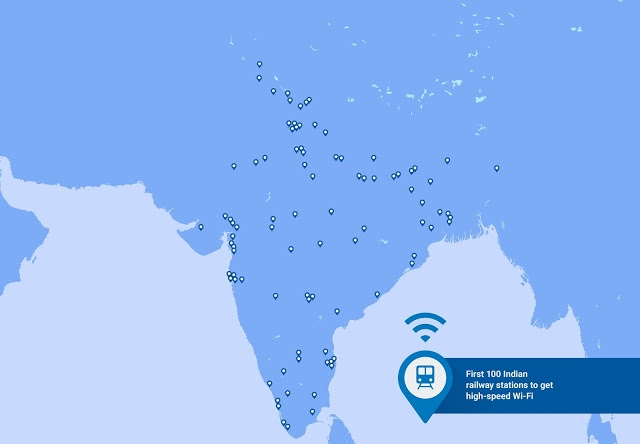
Narendra Modi, PM Modi Google, PM Modi at Google headquarters, Modi at Google headquarters, Modi in Silicon Valley, WiFi in railway stations, Modi Google, Google free WiFi railway stations, Modi in US, Sundar Pichai, Satya Nadella, Satya Nadella Microsoft CEO, Nadella PM Modi, Microsoft CEO meets MOdi, PM Modi Silicon Valley, PM Modi San Jose, Tim Cook Modi, Microsoft Indian Villages, technology, technology news Google’s map of railway stations that will get WiFi in India.
Google CEO Sundar Pichai said that initially high speed Internet will be provided at 100 railway stations by end of 2016 and later to 400 more by the next year.
In an official blogpost, Google’s Pichai wrote,” The network will expand quickly to cover 100 of the busiest stations in India before the end of 2016, with the remaining stations following in quick succession. Even with just the first 100 stations online, this project will make Wi-Fi available for the more than 10 million people who pass through every day. This will rank it as the largest public Wi-Fi project in India, and among the largest in the world, by number of potential users.” The project will start with Chennai.

Pichai has also promised high speed access with this WiFi project. He goes on to note in the blog, ” It will also be fast—many times faster than what most people in India have access to today…” What he doesn’t mention is if Google will be bringing Google Fibre as part of its expansion project.
Google and keyboards in Indic languages: As smartphones become the driver of Internet adoption in India, Google has realised the importance of allowing Indian users to type and interact with these devices in their regional languages.
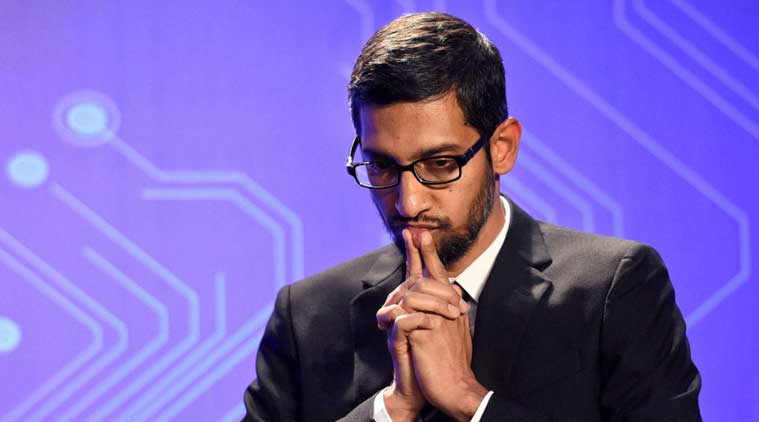
Narendra Modi, PM Modi Google, PM Modi at Google headquarters, Modi at Google headquarters, Modi in Silicon Valley, WiFi in railway stations, Modi Google, Google free WiFi railway stations, Modi in US, Sundar Pichai, Satya Nadella, Satya Nadella Microsoft CEO, Nadella PM Modi, Microsoft CEO meets MOdi, PM Modi Silicon Valley, PM Modi San Jose, Tim Cook Modi, Microsoft Indian Villages, technology, technology news Google CEO Sundar Pichai at the Silicon Valley dinner. (Source: PTI)
From next month, Google will make it possible for people to type in 10 different languages in India, including Gujarati. The feature will go live in the next month.
Microsoft low-cost broadband to 5 lakh villages Microsoft CEO Satya Nadella announced that the company plans to partner with the Indian Government to bring in low-cost broadband connectivity to 500,000 villages in India.
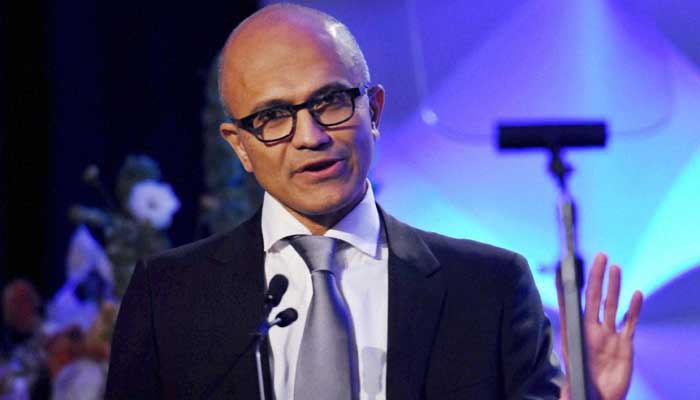
Narendra Modi, PM Modi Google, PM Modi at Google headquarters, Modi at Google headquarters, Modi in Silicon Valley, WiFi in railway stations, Modi Google, Google free WiFi railway stations, Modi in US, Sundar Pichai, Satya Nadella, Satya Nadella Microsoft CEO, Nadella PM Modi, Microsoft CEO meets MOdi, PM Modi Silicon Valley, PM Modi San Jose, Tim Cook Modi, Microsoft Indian Villages, technology, technology news Satya Nadella at the dinner in the honour of the PM. (Source: PTI)
“We believe that lost-cost broad band connectivity coupled with the scale of cloud computing intelligence that can be harnessed from data can help drive creativity, efficiency and productivity across governments and businesses of all sizes,” Nadella said at the meeting with the PM.
Microsoft also announced the availability of its cloud services operating out of India’s data centres, will become operational next week.
Qualcomm and investments for start-ups: Qualcomm, announced a $150 million (approximately Rs 9.8 billion) venture investment fund for start-ups in India via its Qualcomm Ventures.
According to a press statement from Qualcomm, the aim is to fuel start-ups contributing to mobile and ‘internet of everything’ ecosystem and it will provide them with financial, marketing, technology and business support.

Qualcomm also launched a “Design in India Initiative and Competition” to help India become a hub for design capabilities that drive the manufacturing value chain for 3G/4G smartphones, tablets and Internet of Everything (IoE).
Qualcomm will also set up an Innovation Lab in Bangalore to provide technical and engineering support to Indian companies, and support for multiple Indian mobile device design companies.
“We are committed to providing local innovative start-ups with the support needed to help India’s IOE (Internet of Everything) ecosystem grow, increasing consumer choice and availability,” Qualcomm executive chairman Paul E Jacobs said in his remarks at the dinner hosted in honour of Modi.
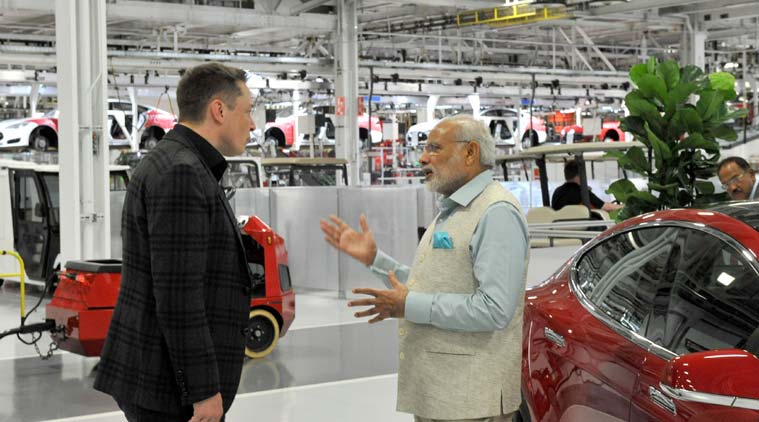
PM Modi and the meeting with Tesla Motors: While there were no concrete announcements after PM Modi and Tesla Motors CEO Elon Musk, as we reported, the meeting was primarily due to India’s interest in the company’s solar Powerwall technology.
Powerwall technology is a new battery by Telsa that will power an entire household. The Powerwall, as the name suggests, goes on a wall in the home and can connect to a solar panel. It will act as a storage for backup power from the panel, as well as full power backup during outages. Read more here.
Tesla CEO Elon Musk and PM Modi. (Source: PIB)  Tesla CEO Elon Musk and PM Modi. (Source: PIB)
For India, where efficient and increasing energy needs are a concern, such a battery holds revolutionary potential. Modi and Tesla founder Elon Musk also discussed the possibility of a more affordable car from the company. Tesla’s Solar-powered cars are fairly expensive, even in the US.
“Enjoyed discussion on how battery technology can help farmers,” Modi said after his hour-long visit to Tesla campus wherein he was given a tour by its CEO Elon Musk. Musk said that he had a “great discussion” with Modi about solar and batteries empowering rural communities.
“For India the main take away was the technology behind long term storage battery, which can have multiple applications,” said Vikas Swarup, spokesman of the Ministry of External Affairs. “The Prime Minister was very keen to see how we could utilize the battery – the Powerwall concept – to leap frog development in India,” he added.
Apple CEO Tim Cook and PM Modi: Prime Minister Modi also invited Apple to set up a manufacturing base in India and its CEO Tim Cook responded positively, Indian officials said.

This Post is appeared on: indianexpress

PM Modi in Silicon Valley: WiFi in railway stations, broadband for villages and more

Read More

Friday, 25 September 2015

CHENNAI: The 50-hour long countdown for Astrosat, India's first dedicated astronomy satellite began this morning at 8am. 

The ISRO website says Mission Readiness Review (MRR) committee and Launch Authorisation Board (LAB) have cleared the 50-hour countdown, which began today. 

Astrosat, India's first space observatory, will fly to its orbit 650km from Earth, on board a Polar Satellite Launch Vehicle (PSLV-C30) that lifts off from the Sriharikota spaceport at 10am on Monday. 

Among its assignments, the 1,153kg Astrosat would look at regions in the universe where stars take birth, and also at black holes. 

The main objectives of Astrosat are to understand high-energy processes in binary systems containing neutron stars and black holes; estimate magnetic fields of neutron stars; study star birth regions and high-energy processes in star systems beyond our galaxy; detect briefly bright X-ray sources in the sky; and perform a limited deep-field survey of the universe in the ultraviolet region. 

The Monday launch also marks Isro's first commercial launch of four US nano satellites. The Lemur satellites from Spire Global are non-visual remote sensing satellite for maritime vessel tracking. 

PSLV-C30 will also carry Lapan-2, a microsatellite from Indonesia and NLS-14, a nanosatellite from Canada, which will also be used for maritime surveillance. 

Countdown begins for India's 1st space observatory

Read More

Saturday, 19 September 2015

The 37-year-old woman was driven around west Delhi early Friday and later taken to a shop where two more men waited. She was gang-raped there.

A woman was kidnapped here in a Meru cab by three people, one of whom was known to her, and then driven to a shop where she was gang-raped, police said on Saturday.
The 37-year-old woman was driven around west Delhi early Friday and later taken to a shop where two more men waited. She was gang-raped there.
In her complaint, the woman said she was gang-raped in a puncture repair shop.
"On the basis of the woman's complaint, a case of gang-rape and abduction has been registered. All the accused have been arrested," said Deputy Commissioner of Police (West) Pushpendra Kumar.
"The woman was kidnapped in Sagarpur near Paschim Vihar and gang-raped at a shop in Peeragarhi. The shop is about 15 km away from the spot from where she was kidnapped," said a police officer.
The woman is separated from her husband and lives in Sagarpur along with her three children. She said she left home at 10.30 p.m. on Thursday to fetch coconut water and medicine from a nearby market. She was walking towards the market when a Meru cab stopped next to her.
Two men who were sitting in the rear seat overpowered her and pulled her inside the car. They gagged her and threatened to kill her if she screamed for help.
"The three men (including a driver known to her) drove her around on west Delhi roads for over an hour during which they were talking to somebody on mobile phone," the officer added.
The woman said two men waited for them at the shop in Peeragarhi. "The five took turns to rape her," the officer said.
At around 4.30 a.m., the accused let off the woman and threatened her with dire consequences if she approached police.
But the woman informed police. A medical examination confirmed has rape.
Meru cabs spokesperson described the incident unfortunate and said: "Meru provided full support to the police by identifying the location of the vehicle, residence address of the driver and background details. This helped the police confiscate the vehicle and nab the driver within hours."

This post is appeared on: Indiatoday

Delhi woman kidnapped in Meru cab, gang-raped

Read More

Friday, 11 September 2015


Two Indians were among 107 killed in Saudi Arabia's holy city of Mecca where a construction crane crashed into the Grand Mosuqe on Friday. The accident also left 15 Indians injured.
"Our officials from the Indian Consulate in Jeddah have been on the ground and monitoring the situation through the night. We have received reports that 15 Indians have been injured are being assisted in various hopsitals," ministry of external affairs spokesperson Vikas Swarup tweeted.
He also said that two Indians have been killed in the unfortunate accident.

This post is appeared on: Hindustantimes

2 Indians killed, 15 others injured in accident at Mecca's Grand Mosque

Read More

Monday, 7 September 2015


State-run telecom service provider Bharat Sanchar Nigam Ltd. (BSNL) on Monday decided to upgrade landline broadband speed to minimum 2Mbps at no additional cost for broadband customers on pan-India basis from October 1.
Union Minister for Communication and Information Technology Ravi Shankar Prasad launched the facility in Gurgaon.
The BSNL's move came in the light of Narendra Modi government's Digital India initiatives.
Speaking on the occasion, Prasad said BSNL works efficiently in natural calamities and it has proved this in Jammu and Kashmir floods, Nepal earthquake and Andhra Pradesh cyclones.
"When BSNL can deliver its services well in natural calamities, then it should be able to provide better services during normal conditions," he said.
Directing the BSNL authorities to evolve a system of complaint redressal, the union minister also asked them to do marketing. "I want your interface with people more frequently."
The country is passing through a changing phase, he said, adding that BSNL has to play a significant role in it.
He recalled that he was minister for communications in Atal Bihari Vajpayee's government as well and when that government left in 2004, BSNL was in profit of Rs. 10,000 crores.
Prasad said once again he has been given the same responsibility and during analysis of records, it was found that BSNL was running in loss of Rs. 8,000 crores. "At that very moment I said that BSNL has to improve and I will support."
He said that BSNL is also offering 1GB free email box to their customers from 50MB mail box.
The minister said the speed upgradation will benefit all the existing and new Broadband customers ofBSNL.
Under this scheme, BSNL is upgrading the speed of existing Broadband plans of 512Kbps and 1Mbps to 2Mbps speed with no extra charge.
"The speed upgradation will benefit all the existing and new broadband customers of BSNL. Under this scheme, BSNL is upgrading the speed of existing Broadband plans of 512Kbps and 1Mbps to 2Mbps speed," the BSNL said in a statement.
BSNL launched the broadband services over its landline in India in 2005, with speed of 256kbps and above over the state-of-art multi-protocol label switching (MPLS) -based IP infrastructure in urban as well as rural areas.
"This upgradation shall enhance customer experience while surfing on Internet and enjoying live video streaming by all customers even in the low price range. This scheme is expected to attract new customers for subscribing BSNL Broadband customers in an affordable manner," the statement added.
Also present on the occasion was union Minister of State for Planning (Independent Charge) and Minister of State for Defence Rao Inderjeet Singh, who said the nationwide facility would give boost to the IT industry.
CMD of BSNL Anupam Srivastava and CGM of Haryana Circle Ambala R.C. Arya were also present on the occasion.
This post is appeared on: Gadgets.ndtv.com

Home | Internet | Internet News BSNL to Boost Minimum Broadband Speed It Offers From 512Kbps to 2Mbps

Read More


Thais were left stunned on Monday after a mystery fireball streaked through clear blue daytime skies in a phenomena that also quickly lit up social media.
Footage from one Bangkok dashboard car camera captured a fireball followed by a brilliant white flash, that was also seen across the country.
"It was the middle of a blue sky day and there was a quick, bright light coming down," said Porjai Jaturongkhakun whose dashcam recorded the scene as he drove to work.
"I usually see shooting stars at night but I have never seen one in the day before," the 30-year-old satellite engineer told AFP.

Porjai was one of a number of Thais who managed to capture the dramatic incident on their car dashboard cameras -- with such footage and witness accounts quickly going viral on social media.
"It was a meteor for sure, I am confident, because it was fast and very bright", Voravit Tanvuttibundit, adviser to the National Astronomical Research Institute of Thailand told AFP on Monday.
"It is a normal occurrence but the meteor this morning was especially big and very bright", Voravit explained, adding that he also witnessed the meteor around 8.40am (0140 GMT).
In a country imbued with superstition, many took the meteor strike as an ill omen.
"It was a bad sign showing the country and the government is in chaos," Facebook user Dilok Jantaradilok wrote.
What we often call "falling stars" are actually tiny bits of space rock that smash into the atmosphere at about 60 kilometres per second, burning up in flashes of light.
Occasionally, much bigger strikes are seen involving larger chunks of debris.
In October 2013, many Russian dashcams captured the astonishing moment a meteor weighing 10,000 tonnes exploded above the Urals, scattering over a wide area and injuring more than 1,000 people.
The force of that meteor explosion was the equivalent to 30 of the nuclear bombs dropped on the Japanese city of Hiroshima during World War II.
Affordable and easy to use dashcams are becoming ubiquitous in many corners of the world, particularly to help settle insurance disputes.

Viral video: Mystery fireball lights up Bangkok skies

Read More

Sunday, 6 September 2015


Mumbai: Odisha girl Ananya Nanda lifted the trophy of the second season of singing reality show “Indian Idol Junior” on Sunday (September 6).
Ananya, 14, who defeated Nahid Afrin and Nithyashree Venkataramanan received the price money of total Rs 10 lakhs.
A self-confessed fan of Shreya Ghoshal and Arijit Singh, the little singing star considers veteran music composer Anandji of the Kalyanji-Anandji duo as her lucky charm.
The grand finale of the Sony show saw all the three permanent judges including Sonakshi Sinha, Vishal Dadlani and Salim Merchant boosting the morale of the top three contenders.
The 28-year-old Tevar actress enthralled the audience with a dance routine on her popular numbers Saree Ke Fall SaRani Tu Main RajaPon PonTamanche Pe disco and Party All Night.
Another major highlight of the finale night was a special visit by Sonakshi’s father actor-politician Shatrughan Sinha, who also interacted with the children.
Stand-up comedian Kapil Sharma, who is gearing up for the release of his debut film Kis Kisko Pyar Karu promoted the film on Indian Idol Junior set. He joined the juniors on stage and sang some hit numbers.
Kapil sticked to his comic best and tickled everyone’s funny bone by cracking few jokes.
The finale also marked the homecoming of the top 13 contestants who cheered on for the final three.

Odisha girl Ananya Nanda wins Indian Idol Junior season 2

Read More

Monday, 31 August 2015


Among emerging market Asian economies, apart from Vietnam, only India’s manufacturing PMI showed expansion from the previous month

India’s Nikkei Purchasing Managers’ Index (PMI) for the manufacturing sector for August came in at 52.3, lower than July’s 52.7. But among emerging market Asian economies, apart from Vietnam, India’s manufacturing PMI was the only one that showed expansion from the previous month. All the other economies had readings below 50, which indicate a contraction in the manufacturing sector from the previous month. Indian manufacturing growth may be sluggish, but at least it’s growing.
Vietnam’s manufacturing PMI was 51.3, lower than India’s. Japan, which is a developed economy, had a manufacturing PMI of 51.7 for August, below India’s rate of expansion.
Here is a compilation of comments in the Markit press releases about the Asian PMIs for August:
China: The quickest deterioration in operating conditions for over six years.
Indonesia: Eleventh consecutive monthly deterioration in business conditions.
Vietnam: Output growth slows to 10-month low.
South Korea: A solid deterioration in operating conditions at manufacturers.
Taiwan: The fastest deterioration in overall operating conditions faced by manufacturers for 35 months.
Malaysia: The strongest deterioration in operating conditions at manufacturers in nearly three years.
India: At 52.3 in August, down from July’s six-month high of 52.7, the seasonally adjusted Nikkei India Manufacturing Purchasing Managers’ Index (PMI) pointed to a further, although weaker, improvement in the health of the sector.
The key takeaways from the data are:
1) The Asian region is seeing a huge slowdown, partly the result of the spluttering of their export-led growth model and partly the effect of the slowdown in China.
2) India stands out as a beacon of growth in Asia.
3) As Pollyanna de Lima, economist at Markit, points out about India: ‘As inflation concerns fade and demand growth loses momentum, further accommodative policy should not be discounted.’
In other words, a rate cut could further boost Indian growth

This post is appeared on: Livemint

India’s manufacturing PMI: best in Asia

Read More


The emergence of an IP and technology-based leader from India will have a bigger long-term impact than a few Indians heading major global firms

sn’t it strange that we were obsessed with happenings at Google while the really momentous news of the coming of age of a serious desi challenger got lost in the noise?
Sundar Pichai and Google
News of Sundar Pichai’s ascension to the Google throne hogged media headlines for almost a week.
While I could understand the excitement instigated by the front page of Dainik Bhaskar in a young tier-II and tier-III city audience for whom a compensation of Rs.300+ crore would seem out of this world (however misleading that figure is since Pichai’s actual compensation in his new role is not known, and conversion from dollars to rupees doesn’t make sense anyway), the hoopla in the metro-based English language press was surely misplaced.
After all, what’s surprising? Indians including Ajay Banga (MasterCard), Victor Menezes (Citibank), Indra Nooyi (PepsiCo) and Anshu Jain (Deutsche Bank) have been CEOs of global corporations. And it’s now more than 20 years since Rajat Gupta became the CEO of the world’s top management consulting firm—McKinsey and Co.
Indians are smart, ambitious and can communicate well. Once they have studied at a top US university and worked there for a while, they fit well into American corporate life, capable of discussing football and technology, and being politically correct. Most importantly, they can be quite conformist and refrain from rocking the boat. Clearly a good choice if you are a culturally diverse company like Google.
And, mind you, this may not really be the throne anyway as Larry Page and Sergey Brin are just one degree of separation away.
I have nothing against Pichai, who appears to be a perfectly competent technical manager with the right credentials. But for me, there were more interesting and promising events happening recently that didn’t get the attention they deserve.
What we should have focused on...
For years now, we have bemoaned the absence of a Google-like company from India. Yes, we have had successful tech enterprises from India, but these have been in the difficult-to-relate-to business-to-business IT services space. The real big news of the last few weeks is that we now see some green shoots pointing to the emergence of an IP (intellectual property) and technology-based leader from India.
On 5 August, in a virtuoso performance that had a clear Steve Jobs touch to it, the CEO of InMobi, Naveen Tewari, introduced his company’s new advertising platform, Miip, to a gathering of who’s who in the technology world at Bengaluru.
For the technological cognoscenti, InMobi is not a new company. It calls itself the “world’s largest independent mobile advertising platform”.
Funded by SoftBank , Kleiner Perkins Caufield and Byers, and Sherpalo to the tune of $220 million, InMobi reportedly served 2.2 trillion advertisement requests in 2014. Its revenues are not in the public domain though some reports suggest that they could be as high as $500 million.
So, what is Miip and why is it significant?
Firstly, mobile advertising is huge and growing rapidly. With the shift of the Internet to the mobile, most dramatically underlined by some Indian e-commerce giants’ decision to be “mobile-only”, the clear trend is for advertising on mobile.
Secondly, the whole promise of Internet-based advertising (and now mobile-based advertising) is better targeting and customization. But this promise has to a large extent been belied. I am repeatedly amused by the fact that after I have purchased a ticket from, say, Indore to Delhi, I see online advertisements offering me low-priced Indore-Delhi tickets. These are completely wasted on me.
And, as InMobi keeps reminding us, many users see advertising as a distraction and an intrusion rather than something they find useful or enjoy.
Most existing Internet or mobile-based advertising is intent-driven. You search for something you want to buy by entering it in a dialog box, and the search engine helps you by displaying related advertisements in addition to the search results. Once you have done such a search, related advertisements keep popping up even though the purchase may have been completed or you no longer have the requirement.
Such advertising makes limited use of analytics and doesn’t prompt you to check on other things you may be interested in. The range of products or services offered is also very narrow even though we know that there are hundreds if not thousands of companies that may be offering other products or services that may be of interest.
InMobi’s Miip is a mobile-based discovery platform that not only uses advanced analytics to overcome this problem, but also features a cute mascot that enters into a dialogue with the user to make suggestions and elicit user feedback. Along the way, the user can consult her friends before making a purchase choice using social media. All of this is done with high-quality visual content that exploits the superior graphics of today’s smartphone screens. Together, these enable an enjoyable and comprehensive shopping experience.
What’s significant in this case is that the company is already a strong player in the mobile advertising space, having entered at the right time about seven years ago. This gives it the muscle and the connections to capitalize on a big bet like Miip.
I particularly liked the launch of Miip in San Francisco, Bengalure and Beijing in quick succession, as these could very well represent loci of technological advancement and economic growth for the next decade. Unlike the earlier generation of Indian companies that shunned collaboration, it was good to see InMobi sharing space with important partners like Paytm and Wal-Mart Stores Inc. at the launch event itself.
I have only one regret about InMobi: I wish it wasn’t into push-based advertising that will promote even more consumerism.
India as a product nation
India’s success in services came from our ability to write high-quality software at low cost, without the need to make large irreversible upfront investments in technology or products. Companies like InMobi represent a new frontier where we are taking large bets, and investing in platforms and new technologies.
This article is not only about InMobi, but about this new generation of companies that’s changing the way we do business. If sustained, this trend could help India become a Product Nation. In the long run, that would have much more impact than a few Indians heading major global corporations.

This post is appeared on: .Livemint

InMobi’s Miip may be more important to India than Pichai

Read More

Copyright © 2014 Info Sharing Online | Designed With By Blogger Templates
Scroll To Top